
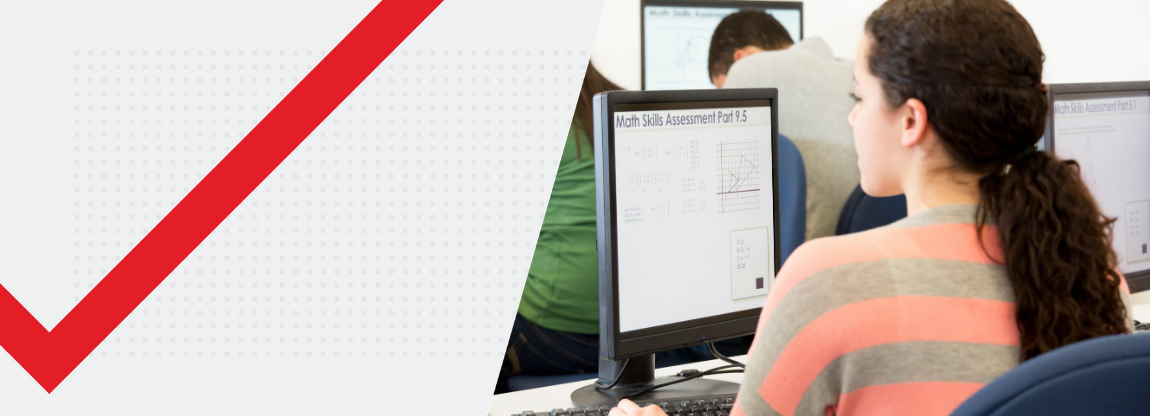
A Matter of Math: How to Improve Your Students’ Skills
“Are you good at math?” Most of us have strong feelings about this, branding ourselves as either stars or duds early in our educational journey. Some people love it as a pure science: As one secondary-level instructor put it, “For me, it’s the sheer pleasure of problem-solving. I always told my students that math is like art: you hang it on a wall not to cover a stain, but to enjoy the view.”1 Others are daunted by its complexity, and fail to see its fundamental connection with daily living.
Why Math Matters
Math has always been an essential element in our everyday responsibilities: creating budgets, evaluating discounts, adapting recipes, calculating service tips, taking measurements, or converting currencies, for instance.
But now, it matters more than ever. The technological advances of the 21st century demand sophisticated skills to comprehend and utilize the data we encounter in our professional and personal capacities. Employers expect their workers to carry out multifaceted tasks requiring problem-solving abilities related to mathematical processes. Competency in math confirms a job candidate’s attention to detail, cognitive aptitude, critical thinking, and data analysis expertise.
Like music, math is a universal language. It is the groundwork for applied knowledge, increasingly important in our modern, global environment. Students in higher education need to master both mathematics (the study of numbers, quantities, geometry, and forms) and numeracy (the application of mathematics to real-world situations) in order to thrive in our contemporary digital era.
The Role of Higher Education
Statistics indicate that our educational systems are letting our children down. A 2012 report from Statistics Canada concluded that students entering higher-education institutions lack adequate math and numeracy skills.2 And, according to a 2018 study by PISA (the Programme for International Student Assessment through the Organisation for Economic Co-operation and Development), Canada steadily plummeted from its top-10 ranking in mathematics education over the past 15 years.3
In analyzing the reasons for a decline in Canadian students’ math proficiency, it has been suggested that the methodologies at the elementary and secondary levels must be upgraded to ensure that students have the necessary skills.
David Munro, a principal research associate for the Conference Board of Canada, observed that universities find that students are not as well prepared in math as in prior years. He recommended that higher-education institutions should consider integrating more literacy, numeracy, and problem-solving into the curriculum.4 A report from the Higher Education Quality Council of Ontario also determined that post-secondary institutions have a role to play in teaching numeracy, rather than leaving it solely in the arena of the lower-level schools.5
A Practical Approach
Students entering post-secondary institutions should be assessed, and encouraged to focus on improvement. Many universities and colleges offer remedial courses and tutoring; however, they are generally directed to students enrolled in math-specific programs. There is no doubt that enriching math competencies would benefit students in every field of study.
What can an educator do to bridge the gap for learners who, through lack of confidence, negative perceptions, or insufficient preparation, are deficient in math skills?
First, present math in a benign light: not as a complex system of unintelligible symbols, but as a logical process that reflects on every aspect of living. Use a variety of tactics to align the instruction to individual learning styles.
Find out what the students’ passions are -- maybe art, music, philosophy -- and identify their links with math. By speaking to their personal interests, you can motivate them to appreciate the broad role of math. Ask them to list all the ways they’re already using math in their lives.
Assign projects that involve practical mathematical applications; for instance, analyzing and comparing energy sources for a clean environment; budgeting for a trip overseas; reviewing games for probabilities.
Stimulate self-assessment: have them make journal entries on the problem they’ve worked on; the steps they took to solve it; the challenges and the triumphs. Establish benchmarks for each student, raising the bar with every success.
Developing multiple customized math exercises is a challenging task, so take advantage of supportive online tools. For instance, ALEKS (Assessment and Learning in Knowledge Spaces) is an affordable web-based artificial intelligence math tutor designed to improve skills in algebra. Through a series of problems, students are assessed on their current status. Based on the results, ALEKS then creates an individualized learning path, assigning problems and providing explanations for the solutions. Students discover exactly where they need help; and instructors can count on the system to help elevate their abilities.
A Vital Difference
Analytical thinking is the basis of mathematics; and its practice applies to any discipline. A firm foundation in math underpins careers in telecommunications, medicine, science, finance, economics, and political science. Data management, problem-solving, technical communications, creative thinking: these are essential prerequisites for our rapidly evolving workplace. And they are grounded in math.
Competency and confidence in math contribute to our wellbeing. You can counteract negative preconceptions in students who might have more aptitude than they realize. Flipping the script will build their self-esteem and equip them for rewarding vocations and the logistics of life.
[1] Ross, Gordon. (retired Ontario secondary-school mathematics teacher), in discussion with the author. March 2021.
[2] Brumwell, S. & MacFarlane, A. (2020). “Improving Numeracy Skills of Postsecondary Students: What is the Way Forward?” Toronto: Higher Education Quality Council of Ontario.
[3] OOECD (2021), Mathematics performance (PISA) (indicator). doi: 10.1787/04711c74-en (Accessed on 27 March 2021) https://data.oecd.org/pisa/mathematics-performance-pisa.htm
[4] Brown, Louise, “Poor math literacy common among Canadian-born university grads,” Toronto Star, November 4, 2014, https://www.thestar.com/yourtoronto/education/2014/11/04/poor_math_literacy_common_among_canadianborn_university_grads.html
[5] Brumwell, S. & MacFarlane, A. (2020). “Improving Numeracy Skills of Postsecondary Students: What is the Way Forward?” Toronto: Higher Education Quality Council of Ontario.