
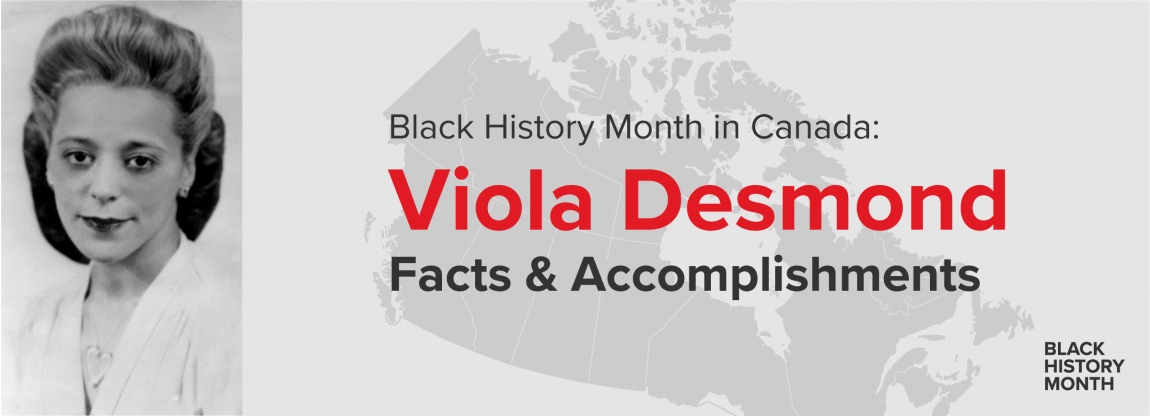
Black History Month in Canada: Viola Desmond Facts & Accomplishments
Canada has long been known for its inclusive nature and its diverse population, but minorities in the country still struggled to earn their place as they did in other countries, including the United States. The idea of devoting a specific period of time to exploring black culture and history in Canada was implemented in 1926, but February officially became Black History Month in 1976. This month is now dedicated to exploring the lives of influential black Canadians in the country, to remembering the storied history of black people in Canada and to focusing on the importance of diversity and equality throughout the entire nation. As part of our Black History Month celebrations, we want to highlight some of the important black figures that played a role in shaping Canada into the wonderful nation that it is today. This post focuses on Viola Desmond, a business woman who refused to accept discrimination as the norm in her country.
Want to help your students learn more about Desmond and her story? Download this printable fill-in-the-blanks work sheet to share with students and help them learn more - don't worry, all of the answers can be found in this blog.
About Viola Desmond
Born and raised in Halifax, Nova Scotia, Viola Desmond originally thought she was destined to be a teacher. While she trained for this profession and prepared to focus her career on education, she ultimately became an influential business woman in the black community in Halifax. Together with her husband, Viola Desmond opened up a beauty salon and barbershop business. She expanded her business into the Desmond School of Beauty Culture, which allowed her to work directly with young black women in the region who wanted to begin their own careers in the beauty industry. This was an ideal way to combine her passion for education, her training as a teacher and her dedication to the community at large. Viola Desmond's business with her husband was a success — so much so, they decided it was time to expand their business throughout the province of Nova Scotia. As they were attending business meetings in the province, Viola Desmond had to make a stop in New Glasgow because her car was having trouble. After taking it to the mechanic, Viola Desmond decided she had some time to spare, and opted to go see a movie at the local theatre in New Glasgow. She had no idea that her decision to go see a movie would catapult her into a situation in which she needed to stand up for her rights, and the rights of all black Canadians, and would earn her a spot in the history books.
The Roseland Theatre Incident and Its Impact
The Roseland Theatre incident occurred on November 8, 1946. In what was an otherwise ordinary day, Viola Desmond made the decision to go to the movies while her car was repaired at a nearby shop in New Glasgow. Not being in her hometown, Viola Desmond was not aware that the local theatre was segregated. Black people who purchased tickets were only invited to sit in the balcony, while the main floor of the theatre was reserved for white customers. Unaware, she purchased her ticket and took a seat on the main floor of the theatre in order to enjoy the film. Employees at the theatre approached her, and told Desmond that her ticket was for an upstairs seat and she would need to move. Thinking there had been a mistake, Desmond returned to the cashier to exchange her ticket and pay the difference for one on the main floor but was refused because of the theatre’s segregation policy. Despite learning the theatre was segregated, Desmond resumed her seat on the main floor of the theatre. Shortly after, Desmond was confronted by the manager of the theatre. Desmond explained she had tried to exchange her ticket for one on the main floor and still refused to move. At this point, law enforcement officers were called into the theatre. The police officers forcibly removed her from the theatre, and in the process, caused Viola Desmond to injure her hip. She was sent to jail, where she had to stay for the night. In addition to violating the segregated seating policy, the theatre also alleged that Viola Desmond did not pay the proper price for admittance. They claimed that main floor seats were taxed higher than balcony seats. At the time of the incident, she had offered to pay the additional tax fee — which was about a 1-cent increase in price — but was not allowed. Despite appealing her conviction twice, Desmond and her legal council were not successful in fighting the charges.
Recognizing Viola Desmond Today
Criminal charges against Viola Desmond were never dropped during her lifetime, but her court case did play a significant role in the fight against segregation in Nova Scotia and throughout Canada. By 1954, segregation was outlawed in the province and black citizens were no longer subjected to separate, segregated facilities. In 1965, at the age of 50, Viola Desmond passed away. She had raised awareness about an important issue, but she died with a mark on her character that she did not know would be erased. In 2010, however, Viola Desmond was granted a free pardon by the governor of Nova Scotia. The pardon was the result of the hard work of Viola's sister, who had advocated for the cause for nearly a decade prior. Today, Canadians are still recognizing the influence of Viola Desmond's bravery and ability to stand up for what is right. In December 2016, it was announced that Viola Desmond would become the first Canadian woman to appear on the $10 bill. The purple bank note with Viola Desmond's image will begin to be printed in 2018, and stands as further proof that while her struggle was unjust and unfair in many ways, it made a big difference in the lives of not only black Canadians but all Canadian citizens who enjoy a society free from the burdens of discrimination and segregation. Viola Desmond is just one example of the bravery and dedication of thousands of black Canadians who have worked to reduce discrimination and fight for equal rights in the country. By learning about the contributions of these individuals and understanding the struggles that they underwent in order to achieve their goals, we can learn to improve our own societal structure. As we change the norms associated with race and discrimination, we will be able to minimize and hopefully eliminate the struggle of black people as well as all minorities in Canada. Hopefully, the history books in the decades to come can tell a different story about the black experience in Canada — one filled with equality, opportunity and assurance for the future.
Want to help your students learn more about Desmond and her story? Download this printable fill-in-the-blanks work sheet to share with students and help them learn more - don't worry, all of the answers can be found in this blog.