
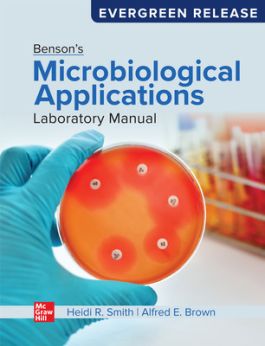
Benson's Microbiological Applications Laboratory Manual: 2025 Release
Receive via shipping:
Colour, print bound version of the complete text
- Part 1 Microscopy
- 1. Brightfield Microscopy
- 2. Darkfield Microscopy
- 3. Phase-Contrast Microscopy
- 4. Microscopic Measurements
- Part 2 Survey of Microorganisms
- 5. Microbiology of Pond Water - Protists, Algae, and Cyanobacteria
- 6. Ubiquity of Bacteria
- 7. The Fungi: Molds and Yeasts
- Part 3 Manipulation of Microorganisms
- 8. Aseptic Technique
- 9. Pure Culture Techniques
- Part 4 Staining and Observations of Microorganisms
- 10. Smear Preparation
- 11. Simple Staining (Observing Bacterial Cell Morphology)
- 12. Negative Staining
- 13. Capsular Staining
- 14. Gram Staining
- 15. Endosphere Staining
- 16. Acid-Fast Staining: Kinyoun Method
- 17. Motility Determination
- Part 5 Culture Methods
- 18. Culture Media Preparation
- 19. Enumeration of Bacteria: The Standard Plate Count
- 20. Slide Culture: Fungi
- Part 6 Bacterial Viruses
- 21. Determination of a Bacteriophage Titer
- 22. Isolation of Phage from Flies
- 23. Phage Typing
- Part 7 Environmental Influences and Control of Microbial Growth
- 24. Effects of Oxygen on Growth
- 25. Temperature: Effects on Growth
- 26. pH and Microbial Growth
- 27. Water Activity and Osmotic Pressure
- 28. Ultraviolet Light: Lethal Effects
- 29. The Effects of Lysozyme on Bacterial Cells
- 30. Evaluation of Alcohol: Its Effectiveness as an Antiseptic
- 31. Antimicrobic Sensitivity Testing: The Kirby-Bauer Method
- 32. Evaluation of Antiseptics: The Filter Paper Disk Method
- 33. Effectiveness of Hand Scrubbing
- Part 8 Identification of Unknown Bacteria
- 34. Morphological Study of an Unknown Bacterium
- 35. Cultural Characteristics
- 36. Physiological Characteristics: Oxidation and Fermentation Tests
- 37. Physiological Characteristics: Hydrolytic and Degradative Reactions
- 38. Physiological Characteristics: Multiple Test Media
- 39. Use of Bergey’s Manual
- Part 9 Miniaturized Multitest Systems
- 40. Enterobacteriaceae Identification: The API 20E® System
- 41. Enterobacteriaceae Identification: The Entero-Pluri- Test System
- 42. Staphylococcus Identification: The API® Staph Test System
- Part 10 Applied Microbiology
- 43. Bacterial Counts of Foods
- 44. Bacteriological Examination of Water: Most Probable Number Determination
- 45. Bacteriological Examination of Water: The Membrane Filter Method
- 46. Reductase Test
- 47. Temperature: Lethal Effects
- 48. Microbial Spoilage of Canned Food
- 49. Microbiology of Alcohol Fermentation
- Part 11 Bacterial Genetics and Biotechnology
- 50. Polymerase Chain Reaction for Amplifying DNA
- 51. Bacterial Transformation
- 52. CRISPR-Cas9 System
- Part 12 Immunology and Serology
- 53. The Staphylococci: Isolation and Identification
- 54. The Streptococci and Enterococci: Isolation and Identification
- 55. Gram-Negative Intestinal Pathogens
- 56. A Synthetic Epidemic
- Part 13 Immunology and Serology
- 57. Slide Agglutination Test: Serological Typing
- 58. Slide Agglutination Test for S. aureus
- 59. Slide Agglutination Test for Streptococcus
- 60. Enzyme-Linked Immunosorbent Assay (ELISA)
- 61. Blood Grouping
Benson's Microbiological Applications has been the "gold standard" of microbiology laboratory manuals for over 35 years. This manual has a number of attractive features that resulted in its adoption in universities, colleges, and community colleges.
This title includes functionality within the McGraw Hill eBook that will allow students to print text content. Enabling self-print ensures that students can access and print the most up-to-date content, complete with any new Evergreen updates. By providing students with access to the McGraw Hill eBook either standalone or within our Connect platform, students will have the ability to access this print functionality without the added cost of print materials.