
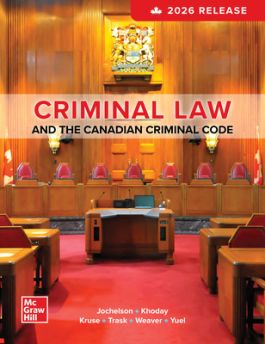
Criminal Law And The Canadian Criminal Code - 2026 Release
Preface
Abbreviations Used for Case Citations
Table of Cases
Chapter 1: Criminal Law in Canadian Context
Chapter 2: The “Physical” Element of a Crime: Actus Reus
Chapter 3: The Mental Element of a Crime: Mens Rea
Chapter 4: Modes of Participation and Inchoate Offences
Chapter 5: Defences, Justifications, and Excuses
Chapter 6: Arrests, Detention, and Pretrial
Chapter 7: Trials
Chapter 8: Sentencing and Restorative Approaches
Glossary
The Canadian 2026 Release of Criminal Law and the Canadian Criminal Code offers a practical and accessible overview of Canadian criminal law. Jochelson features a dynamic new author team from the University of Manitoba. In addition, the 2026 Release has undergone a full redesign, streamlining the structure from 13 chapters to 8, and shifting to an integrated approach that blends foundational concepts with discussions of significant offences. Actus Reus and Mens Rea are now addressed in separate chapters for greater depth, while the Canadian Criminal Code has been moved online for real-time updates. Indigenous perspectives are thoughtfully interwoven throughout. Also new to the 2026 Release are updated case studies, critical thinking questions, and engaging visuals to deepen student understanding. Jochelson reflects the latest amendments, jurisprudence, and systemic challenges, offering a comprehensive and socially conscious exploration of Canadian criminal law.
All New Author Team. The Canadian 2026 Release features a dynamic new author team from University of Manitoba's Faculty of Law, including the Dean, Richard Jochelson, and the Director of Indigenous Legal Learnings and Services, Marc Kruse.
Full Redesign. Jochelson has been thoroughly redesigned to enhance clarity, engagement, and relevance for students. Major updates include a streamlined structure, reducing the number of chapters from 13 to 8, and a shift from the previous two-part division to a more integrated approach. This new format blends foundational concepts of criminal law with discussions of significant offences, providing a comprehensive exploration of criminal procedures and their challenges. To ensure students interact with the most current content, the Canadian Criminal Code has been moved online, allowing for real-time updates. Additionally, Actus Reus and Mens Rea, previously covered together, are now addressed in separate chapters for greater depth and focus. The 2026 Release also features new case studies, images, and critical thinking questions designed to engage students and deepen their understanding of criminal law topics and procedures.
Indigenous Content. Indigenous perspectives and diversity are interwoven throughout, reflecting the critical intersection of race and the law. Marc Kruse, Director of Indigenous Legal Learnings and Services, reviewed the resource to ensure respectful representation and contributed to the newly added Chapter 8: Sentencing and Restorative Approaches.This chapter is divided into three sections:
- Sentencing – Expanded coverage on sentencing practices, with a focus on Indigenous and racialized offenders.
- Restorative Justice – New content on Gladue Courts and other specialized courts, including Domestic Violence, Mental Health, FASD, and Drug Treatment Courts.
- Advancing Access – A deep dive into Indigenous Justice Centres, featuring the Wagmatcook Mi’kmaw Wellness Court.
Evergreen™. Content and technology are ever-changing, and it is important that you can keep your course up to date with the latest content and assessments. That’s why we want to deliver the most current and relevant content for your course, hassle-free. McGraw Hill uses an Evergreen delivery model, which is a product delivery model and experience that provides customers with the most relevant and updated content, tools, and accessibility. Engage students and freshen up assignments with up-to-date coverage of select topics and new questions, all without having to switch editions or build a new course.
Best of Both. Jochelson covers the foundations of Criminal Law theories and concepts with the criminal code. This approach allows instructors to cover the basics while applying the Criminal Code without any sacrifice.
Readability. Jochelson is known for its clear writing style, flow, and presentation of concepts.
Application of the Canadian Criminal Code. Jochelson focuses on application of the Canadian Criminal Code to help students prepare for careers in law and law enforcement, including police officers, security personnel, probation and parole offices, law clerks, and more.
McGraw Hill Connect®. Predictive, Personal and Powered by AI. McGraw Hill Connect is an award-winning digital teaching and learning platform designed to empower students and streamline course management for instructors. With cutting-edge adaptive technology and AI-driven tools, Connect delivers personalized learning experiences that help students achieve their full potential. For instructors, Connect provides comprehensive reporting, actionable data, and valuable insights designed to amplify teaching.
SmartBook®. Within Connect, students have access to SmartBook, McGraw Hill’s adaptive learning and reading resource. SmartBook creates a safe space for learning and confidence building, as students receive immediate and meaningful feedback to help guide their study. By prompting students with questions and assessing individual answers, SmartBook learns what a student knows and identifies which topics they need to practice, giving each student a personalized learning experience and path to success.
ReadAnywhere® App. Read or study when it’s convenient with McGraw Hill’s free ReadAnywhere app. Available for iOS and Android smartphones or tablets, the ReadAnywhere App gives users access to McGraw Hill tools including the eBook and SmartBook or Adaptive Learning Assignments in McGraw Hill Connect. Students can take notes, highlight, and complete assignments offline—all their work will sync when connected to Wi-Fi. Students log in with their Connect username and password to start learning—anytime, anywhere!
McGraw-Hill Connect is an award-winning digital teaching and learning solution that empowers students to achieve better outcomes and enables instructors to improve course management efficiency.
High-Quality Course Material
Our trusted solutions are designed to help students actively engage in course content and develop critical higher-level thinking skills while offering you the flexibility to tailor your course to the ways you teach and the ways your students learn.
Assignments & Automatic Grading
Connect features a question bank that you can select from to create homework, practice tests and quizzes. Dramatically reduce the amount of time you spend reviewing homework and grading quizzes, freeing up your valuable time to spend on teaching.
Analytics & Reporting
Monitor progress and improve focus with Connect’s visual and actionable dashboards. Reports are available to empower both instructors and students with real-time performance analytics.
Seamless Integration
Link your Learning Management with Connect for single sign-on and gradebook synchronization, with all-in-one ease for you and your students.