
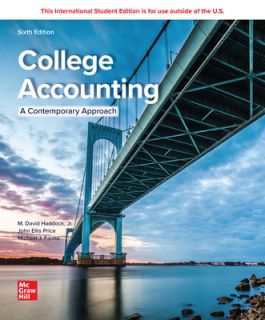
College Accounting (A Contemporary Approach) ISE
1266382569
·
9781266382567
Based on the best-selling text by the same author team,?College Accounting, A Contemporary Approach, 6e?is a streamlined version of the text designed for instructors who teach the course without covering special journals. The authors represent the br…
Read More
Request More Info
Instant access to your textbook via McGraw Hill Bookshelf
- Highlight, search, and take notes
- Offline and mobile access with the free ReadAnywhere app
Note: eBook purchase does not include Connect access.
Chapter 1: Accounting: The Language of Business
Chapter 2: Analyzing Business Transactions
Chapter 3: Analyzing Business Transactions Using T Accounts
Chapter 4: The General Journal and the General Ledger
Chapter 5: Adjustments and the Worksheet
Chapter 6: Closing Entries and the Postclosing Trial Balance
Chapter 7: Accounting for Sales, Accounts Receivable, and Cash Receipts
Chapter 8: Accounting for Purchases, Accounts Payable, and Cash Payments
Chapter 9: Cash
Chapter 10: Payroll Computations, Records, and Payment
Chapter 11: Payroll Taxes, Deposits, and Reports
Chapter 12: Accruals, Deferrals, and the Worksheet
Chapter 13: Financial Statements and Closing Procedure
Chapter 2: Analyzing Business Transactions
Chapter 3: Analyzing Business Transactions Using T Accounts
Chapter 4: The General Journal and the General Ledger
Chapter 5: Adjustments and the Worksheet
Chapter 6: Closing Entries and the Postclosing Trial Balance
Chapter 7: Accounting for Sales, Accounts Receivable, and Cash Receipts
Chapter 8: Accounting for Purchases, Accounts Payable, and Cash Payments
Chapter 9: Cash
Chapter 10: Payroll Computations, Records, and Payment
Chapter 11: Payroll Taxes, Deposits, and Reports
Chapter 12: Accruals, Deferrals, and the Worksheet
Chapter 13: Financial Statements and Closing Procedure
Based on the best-selling text by the same author team,?College Accounting, A Contemporary Approach, 6e?is a streamlined version of the text designed for instructors who teach the course without covering special journals. The authors represent the breadth?of educational environments ensuring that the text is appropriate for all student populations. Throughout, they have adhered to?a common philosophy about textbooks: they should be readable, contain many opportunities for practice, and be able to make?accounting relevant for all.