
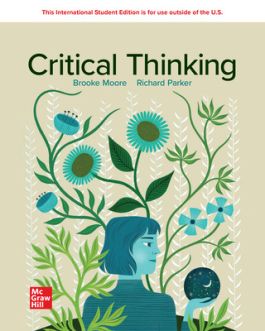
Ise Ebook Critical Thinking, 13E (180 Days)
1264370725
·
9781264370726
In this new edition the authors have expanded on how to improve information acquisitions skills and recognize dubious claims, gravely important in this current climate of “fake news.” In addition, they have revised and expanded the distinction be…
Read More
Request More Info
Instant access to your textbook via McGraw Hill Bookshelf
- Highlight, search, and take notes
- Offline and mobile access with the free ReadAnywhere app
Note: eBook purchase does not include Connect access.
Critical Thinking, 13e
CHAPTER 1: Driving Blindfolded?
CHAPTER 2: Two Kinds of Reasoning?
CHAPTER 3: Clear Thinking, Critical Thinking, and Clear Writing?
CHAPTER 4: Credibility?
CHAPTER 5: Rhetoric, the Art of Persuasion?
CHAPTER 6: Relevance (Red Herring) Fallacies?
CHAPTER 7: Induction Fallacies?
CHAPTER 8: Formal Fallacies and Fallacies of Language?
CHAPTER 9: Deductive Arguments I: Categorical Logic?
CHAPTER 10: Deductive Arguments II: Truth-Functional Logic?
CHAPTER 11: Inductive Reasoning?
CHAPTER 12: Moral, Legal, and Aesthetic Reasoning
CHAPTER 1: Driving Blindfolded?
CHAPTER 2: Two Kinds of Reasoning?
CHAPTER 3: Clear Thinking, Critical Thinking, and Clear Writing?
CHAPTER 4: Credibility?
CHAPTER 5: Rhetoric, the Art of Persuasion?
CHAPTER 6: Relevance (Red Herring) Fallacies?
CHAPTER 7: Induction Fallacies?
CHAPTER 8: Formal Fallacies and Fallacies of Language?
CHAPTER 9: Deductive Arguments I: Categorical Logic?
CHAPTER 10: Deductive Arguments II: Truth-Functional Logic?
CHAPTER 11: Inductive Reasoning?
CHAPTER 12: Moral, Legal, and Aesthetic Reasoning
In this new edition the authors have expanded on how to improve information acquisitions skills and recognize dubious claims, gravely important in this current climate of “fake news.” In addition, they have revised and expanded the distinction between subjective judgments and objective claims and revamped their explanation of inductive reasoning into four different types, introducing them in chapter 2 and further explaining them in chapter 11. This book is not about critical thinking as much as it is a book in critical thinking. The authors work to provide guided practice in what they and instructors think are the most important critical thinking skill sets for students.