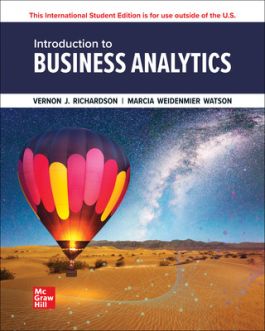
Introduction to Business Analytics ISE

1266496572 · 9781266496578
Introduction to Business Analytics recognizes that students need to develop the skills to ask the right questions, learn to use common workplace tools (such as Excel®, Tableau®, and Power BI®) to examine and analyze data, and interpret results acc… Read More
Lifetime
Available for purchase 2026/06/01
$99.00
Request Review Access
Request More Info

Instant access to your textbook via McGraw Hill Bookshelf

  • Highlight, search, and take notes
  • Offline and mobile access with the free ReadAnywhere app

Note: eBook purchase does not include Connect access.

> Learn more about the McGraw Hill eBook

> Subscription Details

1. Specify the Question: Using Business Analytics to Address Business Questions
2. Obtain the Data: An Introduction to Business Data Sources
3. Analyze the Data: Basic Statistics and Tools Required in Business Analytics
4. Analyze the Data: Exploratory Business Analytics (Descriptive Analytics and Diagnostic Analytics)
5. Analyze the Data: Confirmatory Business Analytics (Predictive Analytics and Prescriptive Analytics)
6. Report the Results: Using Data Visualization
7. Marketing Analytics
8. Accounting Analytics
9. Financial Analytics
10. Operations Analytics
11. Advanced Business Analytics
12. Using the SOAR Analytics Model to Put It All Together:Three Capstone Projects

Appendix A: Excel Tutorial (Formatting, Sorting, Filtering, and
Using Pivot Tables)
Appendix B: Tableau Tutorial
Appendix C: Power BI Desktop Tutorial
Appendix D: Basic Statistics Tutorial
Appendix E: Installing Excel’s Analysis ToolPak Add-In
Appendix F: Installing Excel’s Solver Add-In

Introduction to Business Analytics recognizes that students need to develop the skills to ask the right questions, learn to use common workplace tools (such as Excel®, Tableau®, and Power BI®) to examine and analyze data, and interpret results accurately and effectively to make business decisions. Richardson 1e provides a framework for developing a business analytics mindset called the SOAR analytics model which is composed of four steps— Specify the question, Obtain the data, analyze the data, and report the results. This model is used throughout the text in conjunction with the various types of data analysis that analysts need to perform. The lab activities, which appear at the end of each chapter, follow this framework to reinforce the analytical process. A capstone in the final chapter provides three projects that apply the complete SOAR model.