
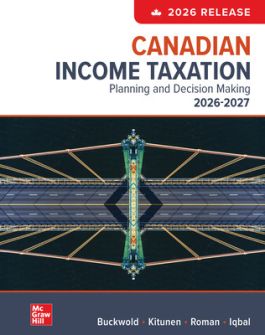
Canadian Income Taxation 2026/2027 - 2026 Release
Receive via shipping:
Colour, print bound version of the complete text
CPA Competency Map
Part 1 A Planning and Decision Making Approach to Taxation
Chapter 1 Taxation—Its Role in Decision Making
Chapter 2 Fundamentals of Tax Planning
Part 2 An Overview of Income Determination and Tax for the Two Primary Entities
Chapter 3?Liability for Tax, Income Determination, and Administration of the Income Tax System
Chapter 4 Income from Employment
Chapter 5 Income from Business
Chapter 6 The Acquisition, Use, and Disposal of Depreciable Property
Chapter 7 Income from Property
Chapter 8 Gains and Losses on the Disposition of Capital Property—Capital Gains
Chapter 9 Other Income, Other Deductions, and Special Rules for Completing Net Income for Tax Purposes
Chapter 10 Individuals: Determination of Taxable Income and Taxes Payable
Chapter 11 Corporations—An Introduction
Part 3 The Corporate Structure
Chapter 12 Organization, Capital Structures, and Income Distributions of Corporations
Chapter 13 The Canadian-Controlled Private Corporation
Chapter 14 Multiple Corporations and Their Reorganization
Part 4 Other Forms of Business Organization
Chapter 15 Partnerships
Chapter 16 Limited Partnerships and Joint Ventures
Chapter 17 Trusts
Part 5 Selected Topics
Chapter 18 Business Acquisitions and Divestitures—Assets versus Shares
Chapter 19 Business Acquisitions and Divestitures—Tax-Deferred Sales
Chapter 20 Domestic and International Business Expansion
Chapter 21 Tax Aspects of Corporate Financing
Chapter 22 Introduction to GST/HST
Chapter 23 Business Valuations
Appendix A Integration 2020
Appendix B Data Analytics (On Connect)
Index
Just as bridges connect parts of Canada together, Canadian Income Taxation: Planning and Decision Making connects tax law and its application, to business and investment transactions and decision making. Taxation is more exciting and interesting—and less complex—than it is reputed to be. The 2026 Release of Canadian Income Taxation: Planning and Decision Making 2026-2027 is written in a manner consistent with this view. Buckwold/Kitunen/Roman/Iqbal develops the fundamental principles of the Canadian tax laws and examines their effect on business decision making and financial planning.
Written in a student-friendly style and refraining, as much as possible, from the use of technical jargon and descriptions of the Income Tax Act, students begin each chapter with a clear understanding of the objectives. Students will find the chapters easy and enjoyable to read and will finish with a sound understanding of the fundamental issues. By adhering to the fundamental framework, complex issues are presented in a clear and concise manner and tied to their practical applications.
Current and Relevant. The changes to Buckwold 2026 Release continue to broaden the subject base and provide current updates, ensuring complete coverage of the taxation competencies in the CPA Competency Map. The primary changes are listed below:
- Proposals from the November 4, 2025 Federal Budget and previously announced changes are incorporated into all relevant chapters.
- Years, prescribed amounts, indexed numbers, tax rates, and announced changes in CRA administrative practices are updated.
- The transfer of a retiring allowance to an RRSP discussion has been removed together with related Key Concept Question Three in chapter nine.
- Demonstration Questions, Review Questions, Key Concept Questions, Problems, and Cases throughout the text are updated and revised to include new topics and reflect tax changes, providing realistic examples of the current tax environment.
- The tax rates and integration tables in Appendix A are updated to show the tax benefit or cost of earning income through a corporation by province/territory.
- Indigenous Taxation in Canada in Appendix B, Data Analytics in Appendix C (online), and the Comprehensive Cases (online) are updated where necessary.
Highly Readable Format. Provides students with the most accessible text for the Canadian Income Taxation course.
Full Coverage of the CPA Competency Map. All the tax topics in the CPA Competency Map Knowledge Supplement are discussed in the text in a manner that is easy to understand.
Decision Making Approach. Fully explains the tax law giving students a deeper understanding of the rules and enhances their ability to apply the rules.
Author Expertise. Joan Kitunen was the co-lead author for the design and development of curriculum and supporting materials for the Elective Module in Taxation, forming part of the CPA Professional Education Program. Joan Kitunen and Bill Buckwold have both received teaching excellence awards at their respective universities. Matthew Roman, CPA, MTax, joins Buckwold and Kitunen as co-author. Matthew is a Senior Tax Manager at?SF Partnership LLP?in Toronto and an experienced tax lecturer. Matthew received the Chartered Professional Accountants of Canada Gold Medal for achieving the highest standing in Ontario on the?Common Final Examination (CFE). Co-author Abraham Iqbal brings over a decade of practical experience in public practice and industry and has been the recipient of numerous teaching awards including the Rotman Teaching Award, and the CPA Canada Jeff Jutzi Memorial Award.
Wealth of Problem Material. A wealth of End-of-chapter Questions (in static and algorithmic format), Problems, and Cases encourage students to apply their knowledge.
Comprehensive Instructor Resources. An Instructor Solutions Manual with complete Income Tax Act references, Test Bank, PowerPoint slides, Solutions to Comprehensive Cases, and Sample course syllabi are available.
McGraw Hill Connect®. Predictive, Personal and Powered by AI.
Buckwold Canadian Income Taxation is available in Connect. McGraw Hill Connect is an award-winning digital teaching and learning platform designed to empower students and streamline course management for instructors. With cutting-edge adaptive technology and AI-driven tools, Connect delivers personalized learning experiences that help students achieve their full potential. For instructors, Connect provides comprehensive reporting, actionable data, and valuable insights designed to amplify teaching.
ReadAnywhere® App. Read or study when it’s convenient with McGraw Hill’s free ReadAnywhere app. Available for iOS and Android smartphones or tablets, the ReadAnywhere App gives users access to McGraw Hill tools including the eBook in McGraw Hill Connect. Students can take notes, highlight, and complete assignments offline—all their work will sync when connected to Wi-Fi. Students log in with their Connect username and password to start learning—anytime, anywhere!
Evergreen™. Content and technology are ever-changing, and it is important that you can keep your course up to date with the latest content and assessments. That’s why we want to deliver the most current and relevant content for your course, hassle-free. McGraw Hill uses an Evergreen delivery model, which is a product delivery model and experience that provides customers with the most relevant and updated content, tools, and accessibility. Engage students and freshen up assignments with up-to-date coverage of select topics and new questions, all without having to switch editions or build a new course.