
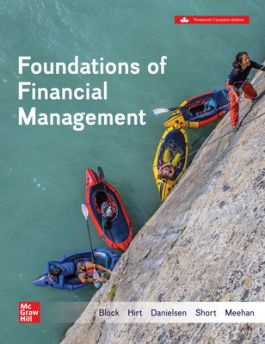
Foundations Of Financial Management
Receive via shipping:
Colour, print bound version of the complete text
Chapter 1: The Goals and Functions of Financial Management
PART 2: FINANCIAL ANALYSIS AND PLANNING
Chapter 2: Review of Accounting
Chapter 3: Financial Analysis
Chapter 4: Financial Forecasting
Chapter 5: Operating and Financial Leverage
PART 3: WORKING CAPITAL MANAGEMENT
Chapter 6: Working Capital and the Financing Decision
Chapter 7: Current Asset Management
Chapter 8: Sources of Short-Term Financing
PART 4: THE CAPITAL BUDGETING PROCESS
Chapter 9: The Time Value of Money
Chapter 10: Valuation and Rates of Return
Chapter 11: Cost of Capital
Chapter 12: The Capital Budgeting Decision
Chapter 13: Risk and Capital Budgeting
PART 5: LONG-TERM FINANCING
Chapter 14: Capital Markets
Chapter 15: Investment Underwriting
Chapter 16: Long-Term Debt and Lease Financing
Chapter 17: Common and Preferred Stock Financing
Chapter 18: Dividend Policy and Retained Earnings
Chapter 19: Derivative Securities
PART 6: EXPANDING THE PERSPECTIVE OF CORPORATE FINANCE
Chapter 20: External Growth through Mergers
Chapter 21: International Financial Management
Appendices
Glossary
Index
Formulas
The thirteenth Canadian edition continues to make finance accessible to students and has been updated to include new real-world examples and problem material.
- Lessons learned from the 2008 financial crisis as well as the impact of COVID-19 and the business adjustments made.
- Streamlined discussions in bullet-point form are included where appropriate to allow for greater focus and attention to key ideas.
- The spreadsheet illustrations and their use in chapters 9, 10, and 11 have been altered to reflect the functions (fx) built into excel spreadsheets.
- All Finance In Action boxes have been re-examined for appropriateness and have been updated. Some new FIAs have been added in light of COVID-19 and its impacts. Web links have also been updated here to help students explore further research on these topics.
- Numerous problems have been revised and updated from the previous edition, as suggested and requested by reviewers.
NEW ALGO TEST BANK
This added test bank features algorithmic questions for testing chapter learning objectives to help meet academic integrity needs.
CANADIAN PERSPECTIVE. Familiar and new examples from the markets illustrate financial concepts, including examples from Canada and around the world. The Canadian perspective presented in Foundations of Financial Management through the text material and the Finance in Action (FIA) boxes, helps students to relate to the content.
PROBLEM-SOLVING APPROACH. The problem-solving approach provides a variety of problem materials that gives students the opportunity to practice and apply financial concepts, developing the skills and confidence needed to understand financial management.
REAL-WORLD RELEVANCE. Over 100 popular Finance in Action (FIA) boxes are integrated throughout the text and deal with the difficulties and opportunities in the financial markets. These boxes engage students and provide opportunities for rewarding discussions of current and historical financial events, issues, and practices.
EXTENSIVE PROBLEM MATERIAL. Block provides a wealth and variety of end-of-chapter material including discussion questions and problems, comprehensive problems, spreadsheet templates, and mini-cases.
CONNECT. McGraw-Hill Connect is a highly reliable, easy-to-use homework and learning management solution that utilizes learning science and award-winning adaptive tools to improve student results. With Connect's new ReadAnywhere app, students can study on the go - including reading and listening using the audio functionality - without any need for internet access. Using Connect, instructors can take advantage of McGraw-Hill's trusted content to seamlessly deliver assignments, quizzes and tests online.